
Most legal disputes don’t begin in courtrooms.
They begin at dining tables, years after someone is gone, with one painful sentence:
“He never said this is what he wanted.”
A will exists to prevent that moment.
In India, Most families don’t avoid writing a will because they don’t care.
They avoid it because the subject feels heavy, uncomfortable, and distant.
But a will is not a document about death.
It is a document about care.
It is a calm, thoughtful decision that says:
“I want my family to be protected, guided, and spared from confusion.”
In a country where family bonds run deep and property often carries emotional weight, a clearly written will becomes one of the simplest ways to ensure peace continues even in your absence.
This guide is written with that belief at its core:
That understanding the law should bring reassurance, not fear — and that one informed step today can quietly safeguard your family’s tomorrow.
Thousands of families face inheritance disputes not because assets were unclear, but because the legal process of making a will was misunderstood or ignored.
This blog is written with one purpose: legal awareness.
No jargon. No fear. Just clarity.
What Is a Will, Really?
Legally speaking, a will is a declaration of a person’s intention regarding the distribution of their property after death.
Practically speaking, it is:
- A tool to prevent disputes
- A way to protect dependents
- A legally recognised voice that speaks when you no longer can
Under Indian law, any person of sound mind above 18 years can make a will.
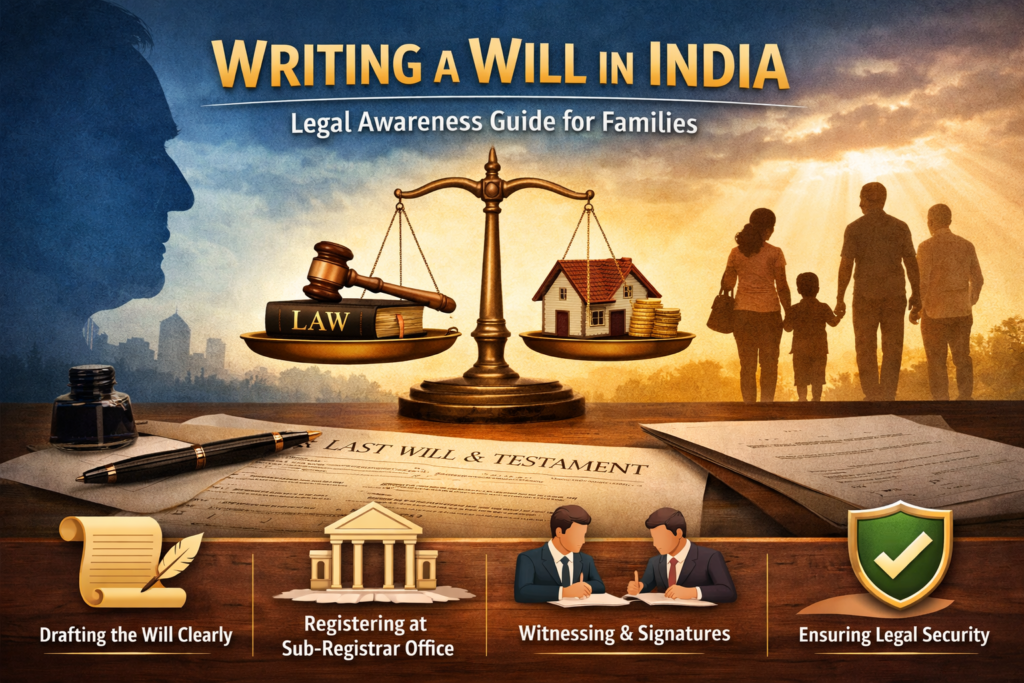
Step 1: Drafting the Will – Clarity Over Complexity
One common myth is that a will must be drafted in complex legal language or on stamp paper.
That is not true.
A valid will in India requires:
- Clear identification of the testator (the person making the will)
- A clear list of assets
- Clear identification of beneficiaries
- Clear instructions on distribution
- Date and signature of the testator
Simple language is not a weakness.
In fact, courts prefer clarity over creativity.
Step 2: Registration – Optional but Powerful
Legally, an unregistered will is valid.
But from a dispute-prevention perspective, registration is strongly recommended.
Registration:
- Creates an official government record
- Reduces allegations of fabrication
- Makes suppression or destruction of the will difficult
Registration is done at the Sub-Registrar’s Office and requires the physical presence of the testator.
Step 3: Witness Identification and Signatures – The Legal Backbone
This is the most critical step in will execution and registration.
Under Indian law, a will must be attested by at least two witnesses.
Who can be a witness?
- Any adult of sound mind
- Preferably not a beneficiary under the will
- Someone with valid identity proof
Why are witnesses so important?
Witnesses legally confirm three things:
- The testator signed the will voluntarily
- The testator appeared to be of sound mind
- The signing took place in their presence
At the Sub-Registrar’s Office:
- The identities of the testator and witnesses are verified
- The testator signs the will
- Witnesses sign in the presence of the Sub-Registrar
This single moment becomes crucial years later if the will is challenged in court.
In litigation, witness testimony often decides the fate of a will.
Step 4: Registration Fees – Affordable Legal Security
Another misconception is that registering a will is expensive.
In reality:
- Registration fees are nominal
- No stamp duty is payable on a will
- Fees vary slightly from state to state
Compared to the cost of future litigation, registration is one of the cheapest legal safeguards available.
Step 5: Safe Custody and Legal Recognition
Once registered:
- The will is scanned and indexed
- It becomes part of official government records
- Certified copies can be obtained when required
This ensures that even if the physical copy is lost, the will does not disappear legally.
Important Legal Awareness Points
✔ A will can be changed or revoked at any time during the testator’s lifetime
✔ A later will automatically revokes an earlier one
✔ Registration does not make a will irrevocable
✔ Mental capacity at the time of execution is crucial
✔ Witnesses play a decisive role in court proceedings
Why Legal Awareness About Wills Matters
Most inheritance disputes are not about greed.
They are about ambiguity.
Courts don’t decide based on emotions.
They decide based on documents, witnesses, and legal compliance.
A properly drafted and registered will:
- Protects your family
- Reduces litigation
- Saves years of emotional and financial stress
Final Thought
Writing a will is not about planning for death.
It is about planning for order, dignity, and peace.
Legal awareness begins with understanding that:
- The law provides simple tools
- Ignoring them creates complex problems
If this blog helped you understand the process, consider sharing it.
One informed decision today can prevent years of legal battles tomorrow.
About the Author:
Advocate Sanjeev Rajput is a Ahmedabad based litigator and writer who reflects on courtroom experiences, legal advocacy, and the evolving practice of law. Through his writing, he aims to bridge the emotional and intellectual journey of litigation.