
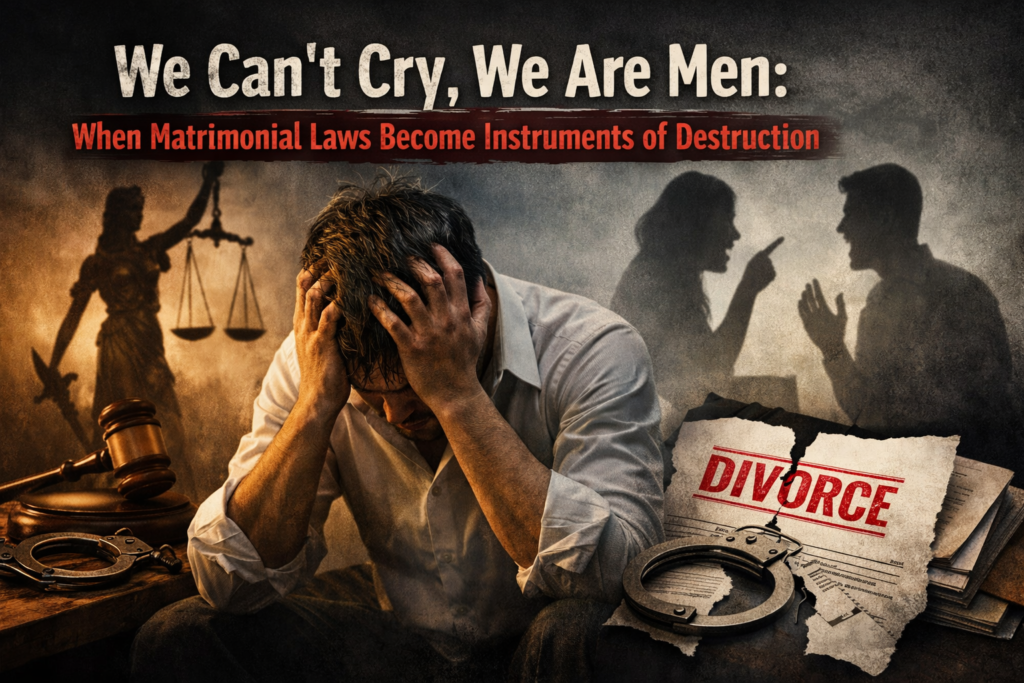
Three suicides expose how misuse of matrimonial laws, false allegations, and prolonged litigation are silently destroying men, families, and faith in justice.
Men are taught early that endurance is strength and silence is virtue. In matrimonial disputes, that conditioning collides with a legal system where allegations often precede inquiry, and compliance is demanded long before truth is examined. When laws meant for protection begin to operate without balance or accountability, they stop being safeguards—and start becoming instruments of destruction. That conditioning does not end in childhood. It follows men into marriage, into police stations, into courtrooms, and into years of litigation.
So when a newspaper headline read—“Three young married men end their lives”—it was not merely shocking. It was indicting.
Three men. Young. Married. Presumably carrying families, responsibilities, and futures. Men who, by every social expectation, were supposed to “handle it.” Yet they reached a point where death felt easier than continuing to live unheard. Instinctively, one question arises
—what kind of pain drives a man to this end?
The newspaper article read like a post-mortem of neglect.
Reasons for suicide: failed marriages trapped in endless litigation. Laws that presumed guilt before hearing truth. Emotional harassment intensified by procedural delays and legal fatigue. Institutions that acknowledged complaints—yet ignored the man at their center.
These deaths were not sudden or impulsive. They were the final consequence of prolonged erasure. Men who suffered openly enough to be crushed, yet silently enough to remain unseen. Men taught that tears were weakness, until silence itself became fatal.
When Protection Mutates Into a Weapon of Destruction
While our laws were rightfully designed to protect women from cruelty, violence, and exploitation, the harsh reality is that some have begun to misuse these very provisions, turning them into weapons of personal vengeance rather than shields of justice.
Take Section 498A of the IPC, for instance — enacted with noble intent to curb cruelty and dowry harassment. Over time, however, it has become one of the most misused provisions, with countless cases where men and even their elderly parents are falsely implicated. Entire families are dragged through years of mental agony, social humiliation, and financial exhaustion — often only to be acquitted after a long and painful legal battle.
Similarly, provisions under the Domestic Violence Act and maintenance laws have at times become tools of pressure rather than protection. Many men are forced to maintain a precarious balance — supporting aged parents, managing their own household, and simultaneously bearing the heavy financial and emotional toll of prolonged litigation and maintenance claims.
The Supreme Court and several High Courts have repeatedly acknowledged this growing issue. Through their judicial activism, they’ve tried to bring balance — reminding that maintenance is not a right to luxury, that false cases of cruelty and domestic violence dragging the near and distant relatives into the litigation must be discouraged, and that both genders deserve justice. Yet, despite these efforts, the ground reality remains grim.
Judicial Recognition, Practical Disconnect
The judiciary has acknowledged this imbalance on multiple occasions.
In Rajnesh v. Neha (2021), the Hon’ble Supreme Court clarified that maintenance is intended to prevent destitution—not to become a source of unearned comfort or punitive extraction.
Earlier, in Mamta Jaiswal v. Rajesh Jaiswal (2000), the Madhya Pradesh High Court observed:
“A well-qualified spouse desirous of remaining idle and not making efforts to find a source of livelihood must be discouraged… A lady fighting matrimonial litigation cannot be permitted to sit idle and put her burden entirely on the husband.”
These judgments echo what many men have been too afraid to say — maintenance is meant for survival, not as a weapon to punish.
Yet, despite these rulings, the suffering continues. Legal processes drag on for years, and the emotional toll destroys families long before justice arrives.
The Cost the Law Rarely Measures
Courts calculate income, liabilities, and expenses. What they rarely assess is psychological endurance.
Men are seldom asked:
- How prolonged litigation is affecting mental health
- Whether financial obligations are sustainable
- What emotional isolation does to decision-making
- How long a person can function under constant legal pressure
There are few institutional safeguards. No structured mental health support. No acknowledgment of emotional vulnerability.
Men are expected to endure. Until endurance fails.
The Headlines That Appear Too Late
Men’s suffering rarely becomes news until it ends in tragedy. There are no widespread social campaigns addressing male mental health in matrimonial disputes. No accessible helplines designed for men facing legal and emotional collapse.
Men are not financial instruments.
They are not legal shock absorbers.
They are not machines designed to absorb blame and payment without question.
They are human beings—sons, husbands, fathers—capable of fatigue, despair, and breakdown.
The suicides reported in newspapers are not isolated incidents. They are symptoms of a deeper structural failure.
Justice Cannot Be Selectively Compassionate
It’s time we acknowledged that justice cannot be gendered.
False allegations destroy lives just as decisively as genuine acts of cruelty. A system committed to equality must protect the innocent regardless of gender, and must examine allegations with seriousness, not assumption.
True equality demands that we protect the innocent — regardless of gender.
What is urgently required is:
- gender-neutral procedural safeguards
- early judicial scrutiny of allegations
- time-bound resolution of matrimonial disputes
- recognition of men’s mental health within family law frameworks
This is not to dilute protections for women, but to restore balance to justice.
Breaking Silence Before It Becomes Final
Empowerment without accountability is not equality. Protection without balance is not justice. A legal system that hears only one voice, no matter how historically justified, risks silencing another to death.
Protecting women is not the problem. The problem begins when protection turns into privilege, and equality loses its fairness.
These suicides we read about are not mere statistics. They are unheard screams — the tragic cost of a justice system that claims to protect, yet chooses to see only one side. They are warnings. And unless the legal system, policymakers, and society at large choose to listen, such headlines will not stop; they will only multiply.
Let us break the silence — not by diminishing women’s struggles, but by recognizing men’s pain too. Let’s work toward a system where responsibility and rights go hand in hand. Where men are not treated as financial instruments, but as human beings with feelings, dignity, and the right to fairness. Only when both voices are heard can equality truly exist.
There must be space for dialogue, for gender-neutral laws, and for justice that listens to both sides. Because when we use one gender as a tool for convenience and the other as a shield for privilege, nobody wins — families break, trust erodes, and humanity loses. Laws must evolve to reflect fairness, not fear. Just as women deserve safety and dignity, men too deserve protection, empathy, and a voice. Because when justice is blind to one half of humanity, society loses its moral balance.
True empowerment cannot come by weakening another. Rights must come with responsibility — for both men and women. It’s time our laws became gender-neutral, our society became empathetic, and our conversations became inclusive.
About the Author:
Advocate Sanjeev Rajput is a Ahmedabad based litigator and writer who reflects on courtroom experiences, legal advocacy, and the evolving practice of law. Through his writing, he aims to bridge the emotional and intellectual journey of litigation.