
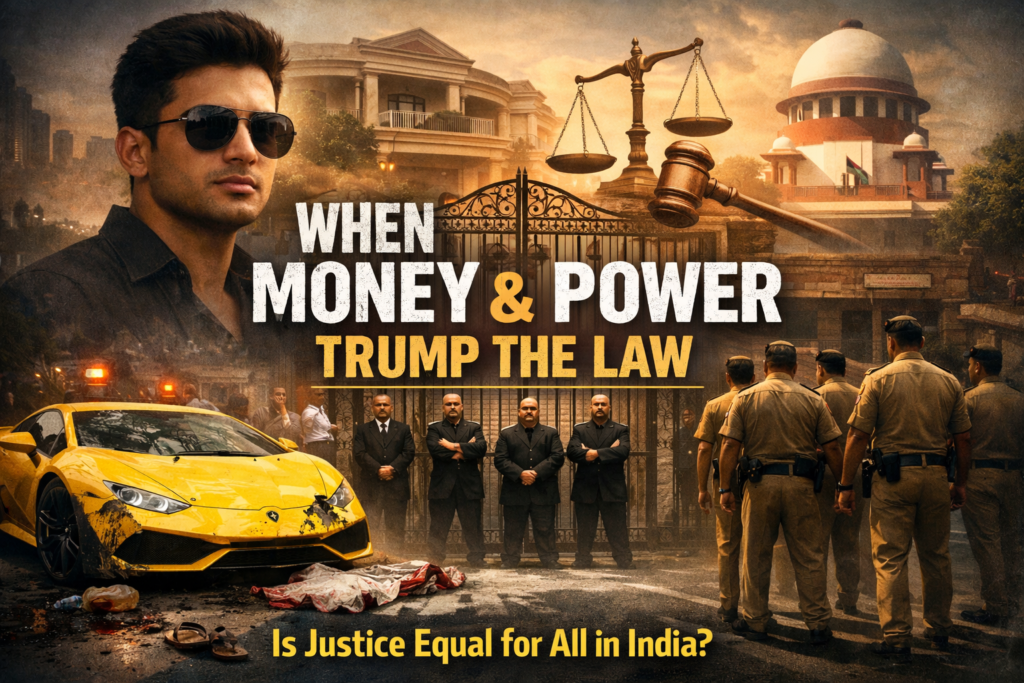
Kanpur Lamborghini Crash Raises Questions About Law, Power, and Accountability
Once again, a tragic incident has forced the nation to confront an uncomfortable question:
Is the law truly equal for all in India?
The Kanpur Lamborghini crash case is not just about a road accident. It is about how justice behaves when wealth, political influence, and institutional power collide with ordinary lives.
According to initial reports, a speeding Lamborghini allegedly driven by Shivam Mishra, son of a tobacco tycoon, rammed into pedestrians. What followed exposed deep cracks in India’s justice delivery system:
- The accused’s name was initially omitted from the FIR
- Police hesitation and procedural delays surfaced
- The local station head was suspended for negligence
- Police officers were reportedly denied entry into the accused’s residence by private security guards
In a constitutional democracy, this single detail speaks volumes.
Is Law Equal to All in India?
This question resurfaces after every high-profile accident involving wealth and influence.
But the truth is uncomfortable.
Had the accused been an ordinary citizen, the response would have been immediate and unforgiving. Names would not disappear from police records. Law enforcement would not hesitate. Arrests would not wait for public outrage.
When poverty meets the law, justice moves fast.
When privilege meets the law, justice negotiates.
Public Silence After High-Profile Crimes
Equally troubling is the absence of sustained public outrage.
We see mass mobilization to defend political leaders. Streets fill when ideology is challenged. Social media explodes over symbols and slogans.
But when innocent citizens die due to reckless privilege?
Silence.
No nationwide protests.
No sustained demands for accountability.
No unified civic response.
Because cases like these do not fit neatly into political narratives. They expose a reality that cuts across party lines — power protects itself regardless of ideology.
Police–Political Nexus and Selective Enforcement
The suspension of a police officer after public backlash is not reform. It is damage control.
The police–political nexus in India is no secret. Transfers, postings, and disciplinary actions are frequently influenced by political considerations. Expecting fearless enforcement without institutional independence is unrealistic.
This is not an isolated failure.
It is a systemic one.
The Uncomfortable Truth About Systemic Failure
There is another truth society avoids confronting.
After such incidents, we blame “the system” in abstract terms. We call it corruption. We divide ourselves along political lines. One party blames another. One ideology attacks the other.
And in doing so, we absolve ourselves.
But the system does not exist in isolation.
Police officers, bureaucrats, political leaders, and judges emerge from the same society that watches silently, rationalizes injustice, and moves on once outrage fades.
A system does not collapse overnight.
It decays gradually — nourished by public indifference, moral convenience, and selective outrage.
Irrespective of which political party is in power, the outcome increasingly looks the same: weakened institutions, eroded accountability, and justice bending under money and influence.
When Law Retreats, Disorder Advances
This collective silence is dangerous.
When money and power become the primary currencies of survival, law recedes into the background. What replaces it is not order — but arbitrariness. A condition where influence dictates outcomes and rules exist only on paper.
Many already fear this drift toward a creeping jungle raj — a system where law is optional for the powerful and punitive for the powerless.
The consequences are visible:
- Loss of public trust
- Brain drain and capital flight
- Citizen disengagement
- Institutional erosion
And it is never the powerful who suffer first. It is the ordinary citizen.
Kanpur Lamborghini Crash Is a Social Indictment
These deaths are not isolated accidents.
They are social indictments.
If systemic failure continues to be treated as a political talking point rather than a collective responsibility, the cost will rise. Justice will become selective. Law will become negotiable. Survival itself will feel uncertain.
Until citizens unite — not behind political parties, but behind constitutional principles — and demand accountability, this cycle will repeat.
More frequently.
More violently.
More openly.
Because a society that refuses to examine itself eventually becomes complicit in its own collapse.
About the Author:
Advocate Sanjeev Rajput is a Ahmedabad based litigator and writer who reflects on courtroom experiences, legal advocacy, and the evolving practice of law. Through his writing, he aims to bridge the emotional and intellectual journey of litigation.